AB-100 Reliable Braindumps Ppt, AB-100 Valid Exam Pdf
Wiki Article
P.S. Free & New AB-100 dumps are available on Google Drive shared by Pass4training: https://drive.google.com/open?id=1vVxew-dPbhHO6pyU3KIA8nVg002Tq7fe
In this website, you can find three different versions of our AB-100 guide torrent which are prepared in order to cater to the different tastes of different people from different countries in the world since we are selling our AB-100 test torrent in the international market. Most notably, the simulation test is available in our software version. With the simulation test, all of our customers will have an access to get accustomed to the AB-100 Exam atmosphere and pass easily in the real AB-100 exam.
In order to make the AB-100 exam easier for every candidate, Pass4training compiled such a wonderful AB-100 study materials that allows making you test and review history performance, and then you can find your obstacles and overcome them. In addition, once you have used this type of AB-100 Exam Question online for one time, next time you can practice in an offline environment. It must be highest efficiently exam tool to help you pass the AB-100 exam.
>> AB-100 Reliable Braindumps Ppt <<
AB-100 Valid Exam Pdf, Popular AB-100 Exams
The best way for candidates to know our AB-100 training dumps is downloading our free demo. We provide free PDF demo for each exam. This free demo is a small part of the official complete Microsoft AB-100 training dumps. The free demo can show you the quality of our exam materials. You can download any time before purchasing. You can tell if our products and service have advantage over others. I believe our Microsoft AB-100 training dumps will be the highest value with competitive price comparing other providers.
Microsoft AB-100 Exam Syllabus Topics:
| Topic | Details |
|---|---|
| Topic 1 |
|
| Topic 2 |
|
| Topic 3 |
|
Microsoft Agentic AI Business Solutions Architect Sample Questions (Q52-Q57):
NEW QUESTION # 52
A company plans to implement an AI solution that will contain a Microsoft Copilot Studio agent and a Microsoft Foundry agent. The solution will be stored in a source code repository.
You need to recommend a deployment method for each agent. The solution must meet the following requirements:
A test environment must be used before a deployment to production.
Production must be isolated from development and testing.
The deployment must be repeatable and fully automated.
The solution must NOT require manual intervention.
Which deployment method should you recommend for each agent? To answer, select the appropriate options in the answer area.
NOTE: Each correct selection is worth one point.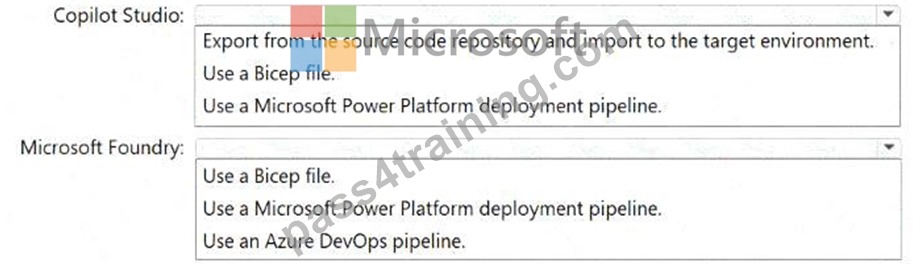
Answer:
Explanation: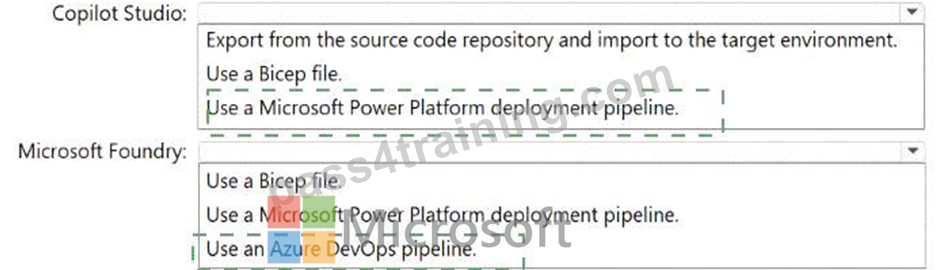
Explanation:
Copilot Studio # Use a Microsoft Power Platform deployment pipeline; Microsoft Foundry # Use an Azure DevOps pipeline
NEW QUESTION # 53
Hotspot Question
A company has a Microsoft 365 E5 subscription and uses Microsoft Copilot Studio.
The company has a Microsoft SharePoint Online library that contains 10,000 policy PDFs from various departments. The library contains a populated column named Department for each PDF.
You need to design a Copilot Studio agent that will use the SharePoint library as a knowledge source. The solution must meet the following requirements:
- Enable the agent to answer user questions about company policies.
- Ensure that the agent can identify which departments and policies are connected.
What should you include in the design for each requirement? To answer, select the appropriate options in the answer area.
NOTE: Each correct selection is worth one point.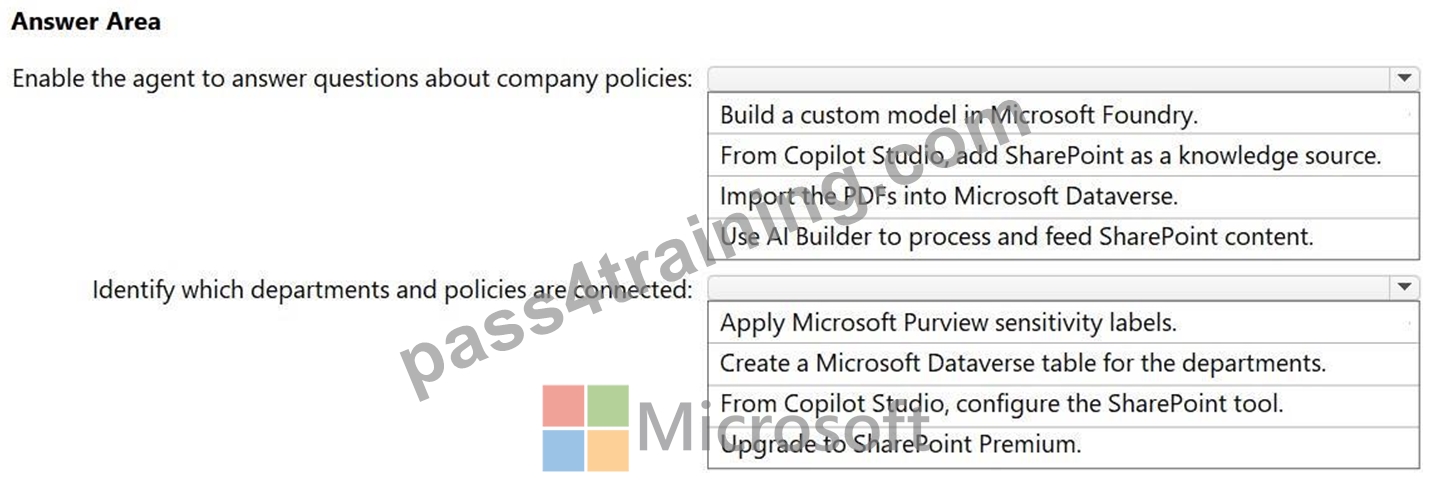
Answer:
Explanation: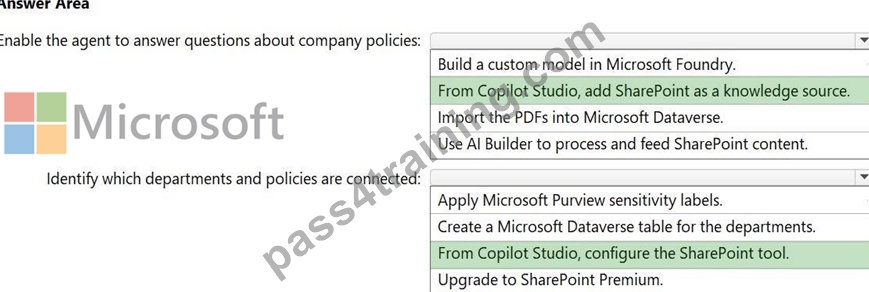
Explanation:
Box 1: From Copilot Studio, add SharePoint as a knowledge source
Enable the agent to answer user questions about company policies.
To enable a Microsoft Copilot Studio agent to answer questions from a large SharePoint Online library using the Department column as a filter, you must configure Generative Answers with specific metadata filtering.
*-> 1. Configure SharePoint as a Knowledge Source
Add the Source: In Copilot Studio, go to the Knowledge tab and select Add knowledge. Choose SharePoint and provide the URL of your site or specific document library.
Authentication: Ensure Manual Authentication with Microsoft Entra ID is configured. The agent requires the Sites.Read.All and Files.Read.All scopes to access documents on behalf of the user.
Indexing: Note that indexing tens of thousands of files can take significant time (days or weeks).
2. Enable Metadata Filtering (Department Column)
To ensure the agent only searches policies relevant to a user's department, you must use Advanced Settings to filter the search results based on your custom column.
Box 2: From Copilot Studio, configure the SharePoint tool.
Ensure that the agent can identify which departments and policies are connected.
The SharePoint tool can be configured directly from Microsoft Copilot Studio to act as a knowledge source, allowing your AI agent to read files, documents, and lists from SharePoint to provide answers.
Note:
To ensure your Copilot Studio agent effectively identifies and connects your "Department" metadata with specific policies across tens of thousands of documents, you must address both search indexing and agent instructions.
To ensure that your Microsoft Copilot Studio agent can identify and filter documents based on the Department column from your SharePoint library, you should configure the Advanced settings of your SharePoint knowledge source to use KQL (Keyword Query Language) filters.
Reference:
https://learn.microsoft.com/en-us/microsoft-copilot-studio/knowledge-add-sharepoint
NEW QUESTION # 54
A company has Microsoft Power Platform development staging, and production environments. Each environment has its own Microsoft Dataverse tables and Azure Al Search index.
You are designing an application lifecycle management (ALM) process to deploy a Microsoft Copilot Studio agent between the environments.
The company has a Copilot Studio agent named Agent! in development. Agent1 uses the following grounding data sources:
* A Dataverse table named CustomerOrders
* An Azure Al Search index named customer-knowledge
You need to deploy Agent1 to production. The solution must ensure that the agent uses the production grounding data sources, minimizes downtime, and handles credentials and endpoints securely.
What should you include in the deployment package solution, and what should you reconfigure after the deployment? To answer, select the appropriate options in the answer area.
NOTE: Each correct selection is worth one point.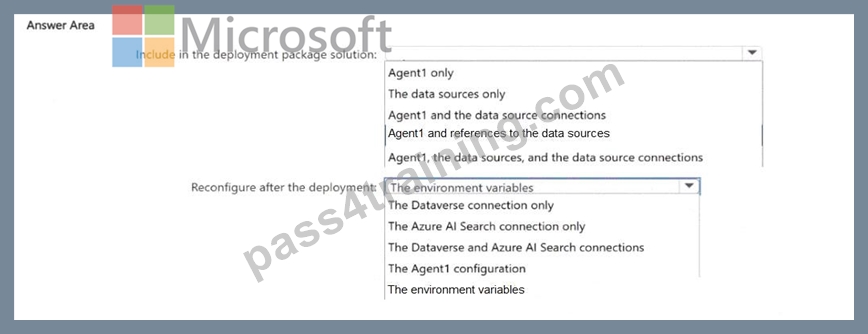
Answer:
Explanation: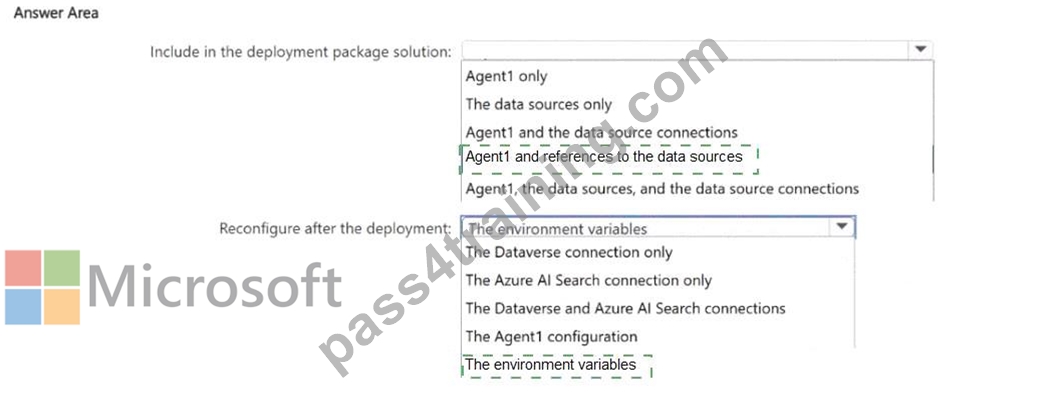
Explanation:
In a proper ALM deployment for Microsoft Copilot Studio across development, staging, and production , you should package the agent in a way that is portable across environments while avoiding hardcoded endpoints, indexes, table targets, or credentials.
Here, Agent1 uses:
* a Dataverse table: CustomerOrders
* an Azure AI Search index: customer-knowledge
Because each environment has its own Dataverse tables and Azure AI Search index, the deployment package should not carry over the development environment's live connections as fixed produc tion settings. Instead, it should carry the agent and the references needed so the target environment can bind to its own production resources.
That is why the correct recommendation is:
* Deployment package: Agent1 and references to the data sources
* After d eployment: Reconfigure the environment variables
Why this is correct:
* Environment variables are the standard ALM-friendly way to externalize settings like:
* endpoints
* index names
* table references
* connection-related values
* This supports secure handling of cr edentials and endpoints
* It also helps minimize downtime , because production values can be switched cleanly after import without rebuilding the agent Why the other choices are weaker:
* Agent1 only would omit needed source references
* The data sources only wou ld not deploy the actual agent
* Agent1 and the data source connections risks carrying environment-specific connection bindings
* Agent1, the data sources, and the data source connections is too tightly coupled to the source environment and is not the best ALM design for secure cross-environment deployment
* Reconfiguring only Dataverse or only Azure AI Search is incomplete because both can vary by environment
* Reconfiguring Agent1 configuration is broader and less precise than using environment variables
NEW QUESTION # 55
A company has an AI business solution.
You need to extend the solution so that Microsoft 365 Copilot can invoke external logic hosted in Azure services.
What should you include in the solution?
- A. Microsoft Power Platform connectors
- B. Microsoft Copilot Studio skills
- C. custom engine agents
Answer: A
Explanation:
To enhance an AI business solution with Microsoft 365 Copilot and integrate external logic hosted in Azure, you should use Copilot Studio to create Actions. These actions act as plugins that allow Copilot to invoke external services through Power Platform components.
Implementation Strategy
Azure Logic Hosting: Host your external logic in Azure using services like Azure Functions or Azure Logic Apps. These provide the API endpoints that Copilot will ultimately call.
*-> Power Platform Connector: Create a Custom Connector in the Power Platform to wrap your Azure service's API. This connector acts as the bridge, translating Copilot's requests into API calls your Azure logic understands.
Copilot Studio Integration: Within Microsoft Copilot Studio, add the custom connector as a Tool or Action. This makes the logic discoverable and invokable by Microsoft 365 Copilot.
Deployment: Deploy the action through the Microsoft 365 admin center under Integrated Apps to make it available to users in Teams or other Microsoft 365 apps.
Key Components
*-> Connector: Wraps the Azure API using an OpenAPI definition or Postman collection.
Plugin/Action: Defines how Copilot identifies when to use the connector based on user prompts.
Authentication: Ensure the connector is configured with appropriate security (e.g., OAuth 2.0) to safely access your Azure resources.
Reference:
https://learn.microsoft.com/en-us/copilot/security/connector-logicapp
NEW QUESTION # 56
A company has Microsoft Copilot Studio agents.
The company plans to deploy custom connectors across development, test, and production environments.
You need to design an application lifecycle management (ALM) process to ensure consistency and prevent direct editing in production. Which two actions should you include in the design? Each correct answer presents part of the solution.
NOTE: Each correct selection is worth one point.
- A. Manually rebuild the agents in each environment.
- B. Include agents and connectors in a solution.
- C. Move the agents between the environments by using data export and import.
- D. Deploy unmanaged solutions to production.
- E. Deploy managed solutions to production.
Answer: B,E
Explanation:
For Microsoft Copilot Studio ALM across development, test, and production , the right approach is to package the app components properly and use controlled deployment in production.
A). Include agents and connectors in a solution is correct because solutions are the standard Power Platform ALM container for moving components consistently across environments. Putting both the agents and the custom connectors into the solution ensures they travel together and remain aligned.
D). Deploy managed solutions to production is also correct because managed solutions are intended for production use. They help prevent direct editing in production and support stronger governance and release control.
Why the other options are not correct:
* B. Move the agents between environments by using data export and import is not the recommended ALM approach for Copilot Studio components.
* C. Manually rebuild the agents in each environment creates inconsistency and increases effort and risk.
* E. Deploy unmanaged solutions to production would allow easier direct modification, which conflicts with the requirement to prevent direct editing in production.
NEW QUESTION # 57
......
The client can try out and download our AB-100 training materials freely before their purchase so as to have an understanding of our AB-100 exam questions and then decide whether to buy them or not. The website pages of our product provide the details of our AB-100 learning questions. You can see the demos of our AB-100 Study Guide, which are part of the all titles selected from the test bank and the forms of the questions and answers and know the form of our software on the website pages of our AB-100 study materials.
AB-100 Valid Exam Pdf: https://www.pass4training.com/AB-100-pass-exam-training.html
- Unparalleled AB-100 Reliable Braindumps Ppt | Easy To Study and Pass Exam at first attempt - Trustable Microsoft Agentic AI Business Solutions Architect ???? ✔ www.pass4test.com ️✔️ is best website to obtain 【 AB-100 】 for free download ❓AB-100 Test Dumps Pdf
- Agentic AI Business Solutions Architect latest Pass4sures torrent - AB-100 pdf vce collection ⏲ Search for ✔ AB-100 ️✔️ and download exam materials for free through 【 www.pdfvce.com 】 ????AB-100 New Dumps Ebook
- Real and Updated Microsoft AB-100 Exam Questions ???? Copy URL ✔ www.verifieddumps.com ️✔️ open and search for ⮆ AB-100 ⮄ to download for free ☂New AB-100 Test Pdf
- 100% Pass-Rate AB-100 Reliable Braindumps Ppt - Leading Offer in Qualification Exams - First-Grade Microsoft Agentic AI Business Solutions Architect ???? Open website ➤ www.pdfvce.com ⮘ and search for “ AB-100 ” for free download ????AB-100 New Braindumps Pdf
- Free PDF 2026 Microsoft Unparalleled AB-100: Agentic AI Business Solutions Architect Reliable Braindumps Ppt ???? Search for [ AB-100 ] and easily obtain a free download on ➡ www.dumpsmaterials.com ️⬅️ ????AB-100 Valid Test Guide
- Exam AB-100 Questions Pdf ???? Free AB-100 Learning Cram ???? Latest AB-100 Study Guide ???? Open ⇛ www.pdfvce.com ⇚ enter { AB-100 } and obtain a free download ????AB-100 Test Dumps Pdf
- Free AB-100 Learning Cram ???? AB-100 Valid Braindumps Files ???? AB-100 Valid Exam Pass4sure ???? Search for ⮆ AB-100 ⮄ and download exam materials for free through ☀ www.practicevce.com ️☀️ ????Pass AB-100 Guide
- Unparalleled AB-100 Reliable Braindumps Ppt | Easy To Study and Pass Exam at first attempt - Trustable Microsoft Agentic AI Business Solutions Architect ???? Search for ➽ AB-100 ???? and download exam materials for free through ➽ www.pdfvce.com ???? ????AB-100 Exam Preview
- Exam AB-100 Quiz ???? Latest AB-100 Study Guide ???? New AB-100 Test Pdf ???? Search for [ AB-100 ] and obtain a free download on ✔ www.easy4engine.com ️✔️ ????AB-100 New Braindumps Pdf
- Agentic AI Business Solutions Architect latest Pass4sures torrent - AB-100 pdf vce collection ???? Search on [ www.pdfvce.com ] for 《 AB-100 》 to obtain exam materials for free download ????AB-100 New Dumps Ebook
- Real and Updated Microsoft AB-100 Exam Questions ???? Enter 《 www.prepawayete.com 》 and search for 【 AB-100 】 to download for free ????Exam AB-100 Questions Pdf
- asiyaufqv031610.iyublog.com, shaniaguvo089411.ziblogs.com, zoezmvd777239.luwebs.com, rsavejl129302.bloggadores.com, rorylcrk571293.bloggosite.com, harmonyjvgn656406.blogsuperapp.com, ianzzip913597.blogdanica.com, aprilifxg391095.blogacep.com, bookmarkblast.com, rafaeldggf150724.nico-wiki.com, Disposable vapes
P.S. Free & New AB-100 dumps are available on Google Drive shared by Pass4training: https://drive.google.com/open?id=1vVxew-dPbhHO6pyU3KIA8nVg002Tq7fe
Report this wiki page